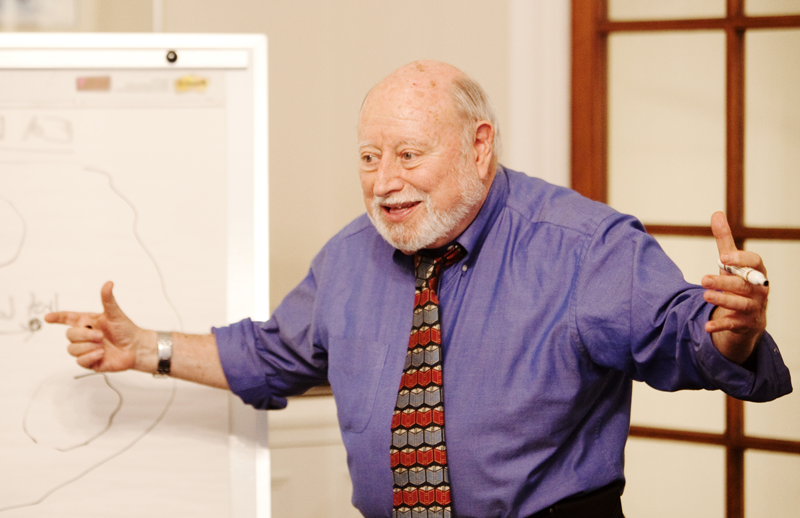
Among Lee’s many legacies to our profession and persons, I’ll focus this evening on the one for which we are gathered.
In a way, I would argue that perhaps his most important contribution is evident in this room: with his characteristic intellectual and academic range, he had been ruminating about the incomplete — maybe that’s a charitable understatement — quality of education research as applied to problems of Jewish education, and together with Susan Kardos came up with the first idea for CASJE.
This was vintage Lee. He understood the importance of metrics of research quality to its improvement — indeed, without so it me sort of definitional parameter it would be hard to sustain an argument about either its quality or the effects of strategies to make it better. But he also knew that all such measures were, at best, estimates of complex constructs that were potentially useful as guideposts or aspirations rather than as fixed and definitive numerical goals. And that if we were serious about applied research to Jewish education we would need a process as much (or more) than a product.
For Lee, the process of engaging with people who shared in the aspiration for evidence-informed progress in the art and science of education, generally and specifically for Jewish education, would be key. Thus, the idea of “consortium,” with all the ambiguities and uncertainties of that word, seemed to Lee (and Susan Kardos, with later help from Chip Edelsberg) as the rational way to proceed. How might scholars with expertise in the various branches of what we call education research — curriculum, instruction, assessment, emotional development, career preparation, funding, accountability, to name a few — join in a communal or collective effort to advance the field? He didn’t work on this exactly from scratch — models from CPRE, the National Academy, other such collaborative entities were in his mind — but he tailored those and his own evolving ideas to what he (and many others) saw as a looming crisis in Jewish education, namely the paucity of research that met the highest standards of academic inquiry.
בקיצור, launching CASJE was one of his proudest achievements, and one that brought him one of his most cherished rewards, namely building a new bridge between education scholars and scholarship (for which he was, obviously, already by then a globally recognized giant) and Jewish civilization. Which leads me to two additional short thoughts that I want to share:
First, for those of us who toil in the often swampy terrains of general education, I recommend keeping Lee in mind not only as a source of “practical wisdom” (to coin a phrase) to guide our craft; but as a model for never being embarrassed — and rather on the contrary, frequently applying with joy and pride — learning from our sages and rabbis and indeed from our Torah itself. To have observed him at meetings of Nobel prize winning physicists and chemists was always a treat (I remember once him suggesting, humbly, that teaching 3rd graders to divide fractions was more challenging than measuring the distance to galaxies light years away or understanding what exactly is black about those black holes). To hear him relate his thoughts on the future of education policy, as product and process, to teachings from the Talmud made the experience even more memorable. Lee knew that as “people of the book” we had much to contribute to the world of general education, and that as humble learners with many centuries of diverse intellectual influence upon our thinking we could open our minds and hearts to the contributions of general education research to our more specific interests and needs in the Jewish world.
Second, coming back again to the process/product point: Hanan Alexander notes in his 2015 book Reimagining Liberal Education, that the great moral and education philosopher Joseph Schwab had introduced the notion of “curriculum deliberation,” which “engages representatives of essential ingredients of curriculum in dynamic discussions about how best to translate theory into practice…” Alexander then makes this connection: “Since there is no one right way to teach a discipline [echoes here of David Tyack’s One Best System], the creation of practical pedagogic wisdom requires the ‘arts of eclectic,’ an integrated application of the most compelling and relevant theories from both the subject matter itself and the study of how best to teach it…” (italics added). Which, as we know, was an influence on Lee’s development of what now has its own acronym and is therefore acceptable here in Washington: PCK, pedagogical content knowledge, the shorthand for what I would argue was and remains a revolutionary appreciation for the complexity of applied education research, the conduct of which hinges on an ever-evolving blend of teacher capacity in both the subject and form of their work. And, at risk of stretching the metaphor beyond its useful limits, CASJE is an embodiment of that aspiration, because we try to bring both the content and form of education research to bear on Jewish teaching and learning in its varied and dynamic contexts.
I’ll close, then, with a modest suggestion. When people ask me what CASJE is about, I sometimes offer this bumper sticker version: Program for Collaborative Knowledge, and let people think about the implied acronym. For me that nicely memorializes Lee’s contribution to our work, our field, our people.
Thanks so much to all of you for being part of this. In memory of Lee, לחיים